

Article
HCA Healthcare’s strategic approach to scaling artificial intelligence


TAGS:
Share:
This article was originally published in Management in Healthcare: A Peer-Reviewed Journal, Volume 10, Issue 4 in June 2026 and is republished here with permission.
Michael Schlosser
Senior Vice President and Chief Transformation Officer, HCA Healthcare

Michael Schlosser, MD, MBA, is the Senior Vice President and Chief Transformation Officer at HCA Healthcare, reporting directly to the company’s Chief Executive Officer. In this role, he leads enterprise-wide digital transformation and innovation, guiding the design, development, integration, implementation and optimization of technologies and processes that enhance clinical, administrative and operational performance. His mission is to improve the experience and outcomes for HCA Healthcare’s leaders, colleagues, care teams and patients. Dr Schlosser oversees the implementation and optimization of electronic health record systems, leads HCA Healthcare’s artificial intelligence and machine learning teams, directs the data office and manages the organization’s Responsible AI program. Previously, he served as Senior Vice President for Care Transformation and Innovation, where he launched HCA Healthcare’s initial digital transformation initiatives. Before that, he was Group Chief Medical Officer, National Group, overseeing clinical operations for 100 HCA Healthcare hospitals with a focus on quality, patient outcomes and clinical strategy. He has also held the role of Chief Medical Officer at HealthTrust. A neurosurgeon by training, Dr Schlosser completed his residency and fellowship at Johns Hopkins. He has served as a medical officer with the Food & Drug Administration (FDA), holds a degree in chemical engineering from MIT and earned his MBA from Vanderbilt University.
Abstract
Hospitals and health systems face mounting pressure to improve patient care while managing workforce strain, rising costs and operational complexity. Artificial intelligence (AI) has the potential to address these challenges. Only 13% of healthcare systems have developed a clear organizational strategy for integrating AI into clinical workflows. Although organizations recognize the need to invest, they struggle to determine where to begin amid numerous options and significant capital requirements. HCA Healthcare has adopted a comprehensive AI strategy — supported by a robust governance framework — to help ensure AI technology is used safely and effectively. HCA Healthcare’s AI strategy emphasizes co-design with clinicians, rigorous validation of impact, change management and governance to help ensure that adoption is safe, effective and trusted. This paper presents an overview of HCA Healthcare’s AI strategy, along with four early initiatives that illustrate how AI comes to life in clinical, operational and administrative functions in its hospitals. These initiatives, as well as the strategy behind them, demonstrate how AI can enhance patient experience, support caregivers and improve operational performance. For example, at one site, an AI tool used across more than 1,000 nursing departments cut scheduling time from hours to just 2 to 3 hours per cycle, enabling nurse leaders to devote more time to patient-centered care. HCA Healthcare’s AI strategy ensures that investments in AI balance innovation with accountability to enable sustainable and transformational impact that other health systems can consider. This article is also included in The Business & Management Collection which can be accessed at https://hstalks.com/business/.
Introduction
For most health systems, the question around implementing artificial intelligence (AI) is no longer whether to invest, but where to start? AI is poised to enable hospitals to solve vexing problems across clinical, operational and administrative functions, improving patient care, caregiver morale and operational efficiency.
Multiple 2025 surveys have found growing interest among clinicians and executives for deploying AI. An American Medical Association survey1 found that two in three physicians use AI in their practice, and noted ‘enthusiasm for the technology is growing even if some doubts still linger’. Sage Growth Partners2 surveyed 100 C-suite hospital and health system executives and found 80 per cent believe AI could improve clinical decision making, while 75 per cent said the tools could improve efficiency and cut costs. Yet, only 13 per cent reported a clear organizational strategy for integrating AI into clinical workflows.
Given the many avenues to pursue and their capital requirements, HCA Healthcare’s AI strategy prioritizes functions that matter most to end-users and have a strategic impact on the enterprise as a whole. HCA Healthcare seeks to balance ambitious yet achievable goals, while ensuring measurable value and responsible AI practices to sustain investment and impact. A crucial complement is a strong commitment to change management and partnership with clinicians to ensure successful AI adoption and integration into workflows.
This paper discusses the evolution of HCA Healthcare’s portfolio approach to investing in AI, presents four examples completed to date and concludes with a framework that other health systems can use to help shape their own AI strategy.
Background
HCA Healthcare is one of the nation’s leading providers of healthcare services and the ninth largest US employer with 189 hospitals and approximately 2,500 other sites of care, including surgery centers, freestanding emergency rooms (ERs), urgent care centers and physician clinics, in 19 US states and the UK. It has a workforce of more than 300,000 employees, which includes 100,000 nurses. As a leading health system, with nearly 47 million patient encounters per year, HCA Healthcare has developed a robust capability to capture and analyze vast amounts of data and use it to transform care. Given its unparalleled size among private US health systems, HCA Healthcare’s data creates enormous value, allowing for real-world trials across heterogeneous populations as well as conventional retrospective research to solve clinical problems. HCA Healthcare’s retrospective and prospective research have set new standards in the areas of maternal care, infection prevention and antibiotic stewardship. This research includes 2024 the INSPIRE3 trials, in which two large multi-state studies conducted at 59 HCA Healthcare hospitals identified a better way to target appropriate antibiotics for patients hospitalized with pneumonia or urinary tract infection, enabling better antibiotic stewardship in hospitals.
HCA Healthcare’s journey into AI began in earnest when it stood up the Care Transformation and Innovation (CT&I) department in 2021. The group collaborated with external technology partners, including Google, Palantir, GE HealthCare, and Augmedix (now a Commure company), to explore using generative AI to streamline administrative tasks for healthcare staff and allow clinicians to spend more direct time with patients, addressing issues identified by care teams.
‘Innovation hubs’ embedded within HCA Healthcare hospitals fostered a culture of innovation and served as laboratories for safely testing ideas, learning from data and new technologies. These efforts were facilitated by a close partnership between technology teams and frontline clinical staff and leaders, always keeping ‘humans in the loop’. The company was not afraid to ‘fail fast’ or iterate with CT&I’s team.
AI has since become central to the company’s overall investment and growth strategy, with a physician-led team of 755 clinicians, data scientists, AI engineers, agile leaders, intelligence analysts, ecosystem and value tracking leaders, developers, educators, digital product analysts and change management and communications practitioners now working as a Department of Digital Transformation and Innovation (DT&I), an enterprise function reporting directly to the CEO.
Operationally, the department is now overseeing the deployment of AI-powered solutions to reduce administrative burden for caregivers and give them more time at the bedside, improve patient safety and outcomes (with limited diagnostic applications to date), reduce the friction in operations and improve supply chain efficiency, among others. (See more below.)
AI and digital technology present a generational opportunity for health care, so HCA Healthcare aligned its vision for DT&I with achieving a transformational outcome. The mindset is not focused on ‘incremental progress’ but rather on deploying scalable technologies that each create value and move care delivery closer to a state of transformation. Given HCA Healthcare’s size scale (consider the lift involved to uniformly deploy a significant workflow change across 189 hospitals with 138,000 clinicians), a framework has been developed to determine where the greatest value can be achieved with the least risk. HCA Healthcare takes a portfolio approach, similar to managing a financial portfolio, to limit risk and maintain momentum across a portfolio rather than a single project.
Building Our Portfolio
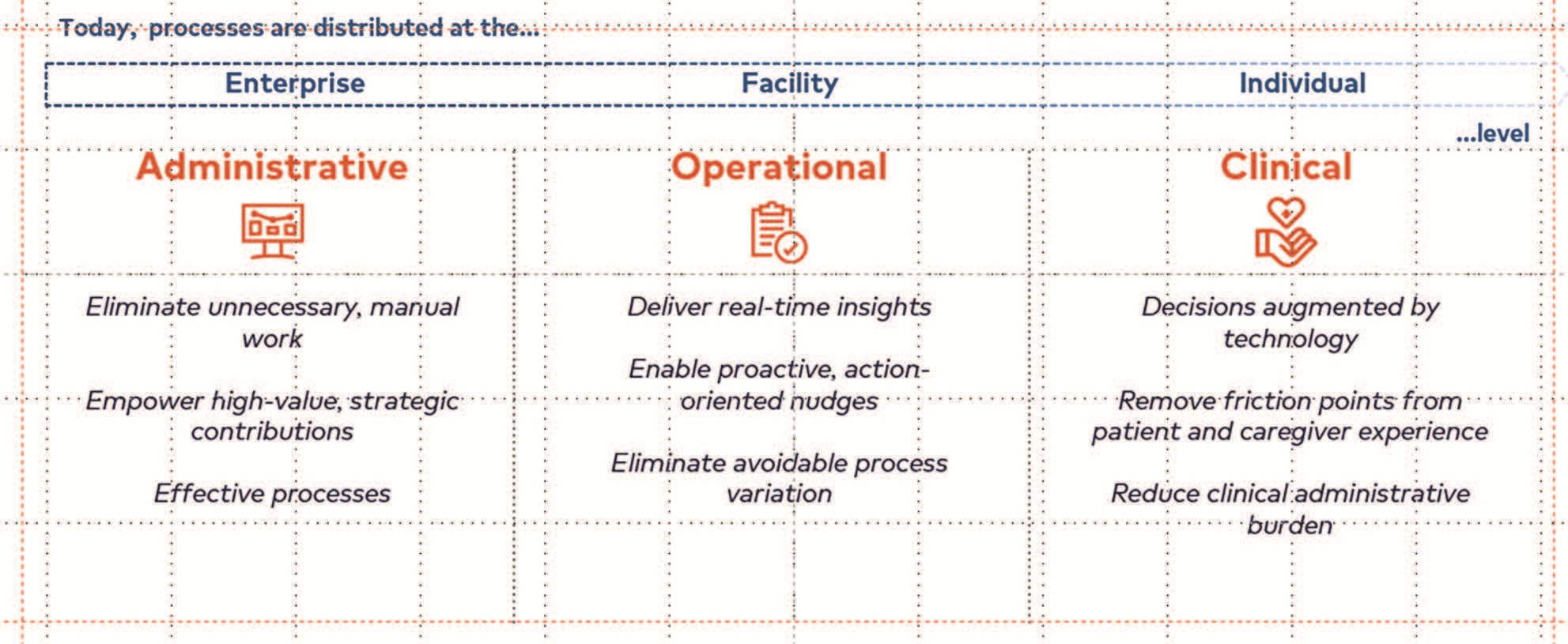
Opportunities to deploy AI exist across every aspect of the business. Focus and establishing clear priorities are pivotal to success. Decisions are framed through priority domains, in a collaborative manner across administrative, operational and clinical business areas (Figure 1). All three areas are important to the organization’s mission and success, but they represent different levels of complexity depending on how standardized and centralized the incumbent processes are across hospitals.
A domain is a strategic focus area for the company defined by a clear set of users, processes and problems to solve, with clear stakeholders and grouped use cases that collectively drive significant impact for HCA Healthcare. Domain leaders and product teams — not the underlying IT — lead with their unique domain expertise, ensuring focus on solving problems and solutions that resonate with end-users in those areas — e.g. AI Enablement, Care Team Optimization, Clinical AI, Clinical Documentation Transformation, Supply Chain and more.
DT&I embraces a more flexible and agile approach to planning and resourcing the portfolio through the Quarterly Business Review (QBR). This transparent process aligns teams with HCA Healthcare’s strategic priorities and user needs, enabling greater agility in shifting resources and focus to the areas of greatest opportunities.
The current portfolio includes six major AI-powered initiatives:
- Nurse Handoffs: This first-of-its-kind digital assistant, designed by nurses for nurses, aims to enhance the reliability and efficiency of communicating patient information at nurse shift handoffs, which occur 24 million times annually in HCA healthcare hospitals.
- Digital Labor Management: The transformational staffing and scheduling platform, called Timpani, is designed to improve nurse workflow and satisfaction, by better matching nursing expertise and preferred work schedules with the projected patient census. It also eliminates time previously spent setting schedules manually.
- Ambient Clinical Documentation: This AI tool leverages ambient speech technology using automatic speech recognition, natural language processing and generative AI to help capture the physician–patient conversation and quickly puts that information into the ER, generating a reliable note that the provider edits and signs.
- Maternal–Fetal Care: The platform is designed to pull information from multiple sources — such as fetal monitoring strips, maternal contraction data, lab results and obstetric history — and present it in a single interface for both nurses and physicians.
- Intelligent Inventory Management: Models are being deployed to optimize inventory management, spot contract noncompliance, analyze contracts and prices and monitor costs, among other functions.
- Hospital Throughput: This initiative is aimed at improving the organization’s capacity to deliver care by ensuring patients move smoothly and safely through the care journey. HCA Healthcare is exploring the use of agentic AI to support this process, helping care teams navigate discharge steps more efficiently and creating additional capacity across the hospital.
The logic and circumstances for each initiative differ, but the impact of an investment is projected in terms of hours or dollars saved or by measurable improvements in patient safety or caregiver morale. This consideration is weighed against the costs and barriers to implementation.
This guidance makes a subject like hospital throughput ripe for AI investment. An overhaul of the discharge process is a major undertaking for any system. If barriers to discharge are reduced with agentic AI optimizing the steps, the downstream impact is enormous. A high-quality discharge process ensures patients leave the hospital safely, with the information, medications and resources they need. Smoother discharges not only benefit patients directly but also help emergency departments maintain capacity to serve others in need.
To be clear, creating value is not solely a matter of financial return. For example, HCA Healthcare has a legacy of pioneering in maternal care, and the US struggles with poor birth outcomes. The organization considers preventing these outcomes vital to its mission. So, it made sense to invest in AI-enhanced fetal monitoring to solve an industry-wide problem.
HCA Healthcare also sees great promise in AI-powered diagnostic tools. There is a recognized need to create a better digital foundation for broad success. Moreover, diagnostic solutions tend to be focused on very niche patient populations, training one algorithm at a time. A tool to improve shift handoffs, for example, would be used millions of times a month.
As momentum continues on this portfolio, several initiatives already demonstrate how the approach moves from concept to measurable impact. Together, they offer a clear view of how the work is taking shape across HCA Healthcare.
Portfolio Spotlight: Nurse Handoff
Communication failures during shift changes are among the most common contributors to preventable hospital errors. National studies have shown that inconsistent or incomplete handoffs increase the risk of adverse events and near misses, underscoring the crucial role that reliable communication plays in patient safety. The challenge is compounded by the time-intensive nature of the process, as nurses often spend valuable minutes navigating fragmented electronic health record (EHR) systems to piece together a complete patient story. Recognizing this industry-wide problem, HCA Healthcare partnered with Google Cloud4 to create Nurse Handoff, a generative AI-powered tool that streamlines and standardizes the process.
Currently Beta tested at eight hospitals, the platform integrates directly with the EHR, generating concise, context-aware summaries of the patient’s current status alongside their full record that is fed to widgets on the nurses’ HCA Mobile Heartbeat configured iPhone. The nurses switching shifts can review, edit and finalize information together in real time, creating more accurate and efficient transitions. The exchange takes place in front of the patient, so the patient can also ask questions, known internally as ‘caring out loud’.
Adoption requires deliberate change management strategy, which makes early stakeholder analysis with frontline nurses and unit leaders crucial to success. During alpha testing, teams conducted interviews and observations to capture concerns and expectations, then iterated the product based on this feedback. By involving nurses throughout development, the program built ownership and trust. This human-centered approach ensured the tool was seen not as a replacement, but as an enabler of safer, more efficient care.
Early pilots at eight hospitals have shown strong promise: nurses rated the tool 97% accurate and 95% helpful. While the project was designed primarily as a quality initiative — focused on improving accuracy and consistency of communication during shift changes — pilots have also demonstrated meaningful efficiency gains. Reported benefits included reduced preparation time, higher confidence in shift transitions and fewer communication-related near misses. Perhaps most importantly, nurses emphasized the value of spending more time at the bedside, with technology operating in the background to support, not replace, their clinical judgment.
If results continue to hold, HCA Healthcare plans to scale Nurse Handoff across its 100,000 nurses.5 The broader lesson for management is clear: addressing universal industry challenges requires pairing innovation with robust change management; early engagement, iterative testing and strong leadership support are as vital as the technology itself.
Portfolio Spotlight: Timpani
Care team scheduling and staffing have long been one of nursing’s most complex operational challenges in hospitals across the country. Departments typically spend 8 to 15 hours a month building schedules; repeated 12 times annually, often resulting in inadvertently inequitable assignments, skill imbalances and excessive reliance on premium labor. The burden on nurse managers is immense.
Now live at more than 130 hospitals, supporting over 1,200 nursing departments, the platform reduces scheduling time to just 2 to 3 hours per cycle. The efficiency comes from AI generating stronger initial schedules that minimize last-minute changes. Previously, schedules were built largely around employee self-scheduling, which often left gaps that had to be filled with costly ‘premium resources’ or contract labor. Timpani enables more intentional planning by aligning staff availability, skill levels and unit requirements at the outset. This reduces scramble, maximizes the use of full-time staff and minimizes manual scheduling effort. At enterprise scale, across nearly 2,000 departments, the cumulative time savings could double, enabling leaders to redirect time towards coaching staff and managing care delivery rather than paperwork.
Change management was central to this success. Initial alpha testing took place in a single unit, with current-state assessments documenting how each department approached scheduling. Leaders found that operational nuances — such as communication with part-time staff or weekend scheduling practices — shaped how difficult adoption would be. These insights allowed for tailored interventions. During beta testing, it became clear that the true unit of change was not frontline staff alone, but nurse managers and directors. Equipping leaders to drive adoption was pivotal to scaling the solution successfully.
Innovative approaches helped engage staff. For example, a bingo game was introduced to help nurses learn how recording preferences could result in the best outcomes for each nurse based on their needs. Combined with personas and empathy mapping, the exercise deepened understanding of user needs and made the change process more approachable.
The impact extends beyond efficiency. By categorizing nurses as beginner, proficient or expert, Timpani balances shift more effectively. Today, >98% of shifts include a mix of skill and experience levels, with <2% staffed entirely by beginners, and those cases are visible in advance so they can be equipped properly, adjusted or recalculated in the future to close the gap. Departments using the tool have also reported a 6% decline in turnover and reduced use of contract labor, driven by more equitable and intentional scheduling.
For management, the takeaway is that technology must be paired with thoughtful change strategies. By investing in readiness assessments, leader engagement and creative staff participation, HCA Healthcare ensured that Timpani was not just adopted but embraced.
Portfolio Spotlight: Maternal-Foetal Care
Maternal outcomes in the United States remain among the worst in the developed world, with a maternal mortality ratio
of 20 maternal deaths per 100,000 live births.6 These outcomes create not only human tragedy but also financial strain, with maternal near misses costing 2.6 times more than standard deliveries and obstetrics ranking as one of the most litigious specialties.
To build on HCA Healthcare’s longstanding commitment to maternal safety, HCA Healthcare has partnered with GE HealthCare to develop a clinical AI platform for maternal–fetal care. Under a nondisclosure agreement, HCA Healthcare contributes clinical data and frontline feedback, while GE HealthCare provides software and data science expertise. The platform is designed to pull information from multiple sources — such as fetal monitoring strips, maternal contraction data, lab results, and obstetric history — and present it in a single interface for both nurses and physicians. This reduces the need to toggle between systems or piece together information through discussion, giving teams a shared, real-time view of the patient’s condition. Labor and delivery was chosen as the initial use case because it functions as a ‘hospital within a hospital’, offering a controlled environment for comprehensive testing.
The first release, announced in October 2025, is being piloted as a unified information hub, consolidating previously disparate data streams — including fetal heart rate monitoring, maternal contraction patterns, lab results, and obstetric history — into a single interface accessible to both nurses and physicians. Instead of toggling across multiple systems or assembling information through discussion, care teams will be able to view the full clinical picture in one place. Automating this interpretation will help standardize fetal heart rate (FHR) review and highlight potential risks quickly, with final judgment always resting with clinicians. Pending FDA approval, advanced features are anticipated in 2026.
To train and validate the AI, HCA Healthcare obstetricians and nurses collaborated to annotate more than 1,000 fetal monitoring strips, documenting major changes in the pattern. Using this ‘ground truth’ approach ensures the model reflects real-world interpretation and can be trusted in practice.
For management, the insight is twofold: improving maternal outcomes demands both urgency and caution, and successful adoption hinges as much on change management as on technological innovation.
Portfolio Spotlight: Ambient Clinical Documentation
Documentation is one of the greatest sources of physician burden. Physicians spend nearly two hours on EHR tasks for every hour of direct patient care. In a 2022 JAMA Internal Medicine study, 58% of physicians reported that documentation7 directly reduced the time they could spend with patients. This imbalance contributes to low physician satisfaction, disrupts the patient–provider relationship and lowers documentation quality.
To relieve this pressure, HCA Healthcare is piloting ambient clinical documentation tools in Texas. These systems use AI to listen during physician–patient encounters, transcribe the conversation and create a draft clinical note. The draft is entered into the EHR, where the physician — as HCA Healthcare’s ‘human in the loop’ — reviews, edits and signs. By automating transcription, the tools relieve physicians of hours of typing or dictating and restore time for patient care.
Effective change management has been pivotal to pilot success. Clinicians are understandably cautious about tools that alter documentation workflows. To build confidence, early deployments emphasized training, peer-to-peer sharing and iterative product improvements based on physician feedback. Forward deployed engineers provided by the technology partner, Commure, allowed for direct input from physicians on templates and other features.
Safeguards also remain central. Physicians are reminded that they bear ultimate responsibility for accuracy. While AI can draft the clinical note, the physician remains accountable for its accuracy; it must precisely reflect what transpired during the encounter. Maintaining accountability ensures patient records remain accurate and clinically reliable.
For management, the message is clear: administrative burden is not peripheral; it directly impacts workforce stability and care quality. When paired with thoughtful change management, ambient clinical documentation can reduce burnout, enhance note accuracy and restore time for patient care.
AI in Healthcare: A Safety and Outcomes Framework
The process to operationalize AI development and adoption is much more complex, with more extensive inputs than presented in the discussion above. For the purposes of this paper, however, the operating model has been summarized as follows, with the recommendation that others to use it as a check list when developing their own AI investments.
1. Structure: Foundations — Technology, People and Shared Vision
Establishes the enabling conditions for safe, effective and trusted AI in health care.
- Compelling Vision and Guardrails
- Clear articulation of the why: the outcomes AI is meant to achieve.
- Explicit boundaries (e.g. augment, not replace clinicians).
- Alignment with organisational mission, patient values and clinical priorities.
- Data and Technical Infrastructure
- Secure, interoperable and high-quality data sources.
- Scalable computing platforms with robust privacy and security controls.
- Model lifecycle infrastructure (versioning, monitoring, audit logs).
- Organisational and Human Capacity
- Multidisciplinary AI governance (clinicians, data scientists, ethicists, patient advocates).
- Clinician champions and AI ‘super users’ embedded in departments.
- Funding for ongoing support and improvement, not just one-time deployment.
- Regulatory and Ethical Alignment
- Compliance with HIPAA, FDA, EU AI Act and other laws, rules and regulations.
- Ethical frameworks addressing bias, fairness and transparency.
- Transparency with care teams, leaders and patients on the use of AI.
2. Process: Design, Integration and Change Management
Covers how AI is developed, implemented and adopted, including transformation of workflows.
- Co-design with End-users
- Clinicians, nurses and operational staff involved from the outset.
- Identification of opportunities to redesign processes, not just ‘bolt on’ AI.
- Pilots and continuous iteration based on real-world use.
- Model Development and Validation
- Rigorous testing on diverse, representative populations.
- Explainability tools for clinicians and operational staff.
- Performance measures beyond accuracy (eg safety, equity, usability).
- Change Management and Adoption
- Clear communication of vision, benefits and limitations.
- Structured training programs and easy access to help resources.
- Ongoing feedback loops for frontline staff to raise concerns or suggest improvements.
- Recognition and reinforcement of positive adoption behaviours.
- Workflow Integration
- AI outputs presented in context, embedded in the clinical workflow.
- Minimal cognitive load; integration into existing systems where possible.
- Human-in-the-loop design with override capabilities.
- Safety and Monitoring
- Real-time drift detection and alerting.
- Post-deployment audits and safety checks.
- Continuous improvement cycles based on outcomes and feedback.
3. Outcomes: Measuring What Matters
Establish clear objectives and key results for every stage of the development and implementation process.
- Clinical Outcomes
- Improved diagnostic and treatment accuracy.
- Reduced adverse events and improved patient safety.
- Measurable health improvements for patients.
- Operational Outcomes
- Reduced clinician administrative burden.
- More efficient patient throughput and resource use.
- Human and Cultural Outcomes
- Clinician trust in AI as a partner.
- Positive changes in team workflows and satisfaction.
- Staff confidence in using AI to improve care.
- Economic Outcomes
- Sustainable return on investment
- (ROI) from AI adoption.
- Cost savings without compromising safety or quality.
The vast transformative potential of AI in health care is emerging as systems seek to tackle longstanding problems with new technology. Choosing where to invest wisely requires systems to develop a framework consistent with their values, culture, resources and readiness to evaluate the potential return not only at HCA Healthcare but throughout the industry.
Conclusion
In summary, HCA Healthcare’s portfolio- based approach to AI demonstrates how disciplined prioritization, clinician partnership and strong governance can translate emerging technology into meaningful impact at scale. The examples presented illustrate that value creation in health care AI extends beyond financial return to include improvements in safety, workforce experience and operational resilience. As health systems navigate an increasingly complex AI landscape, a structured strategy grounded in outcomes, trust and change management is essential for sustainable transformation. These lessons offer a pragmatic blueprint for organizations seeking to deploy AI responsibly while advancing care delivery.
Acknowledgements
This research was supported (in whole or in part) by HCA Healthcare and/or an HCA Healthcare-affiliated entity. The views expressed in this publication represent those of the author(s) and do not necessarily represent the official views of HCA Healthcare or any of its affiliated entities.
References
(1) Albert Henry, T. (2025) ‘2 in 3 Physicians Are Using Health AI — Up 78% from 2023’, American Medical Association, available at https://www.ama-assn.org/practice-management/digital-health/2-3-physicians-are-using-health-ai-78-2023 (accessed 17th September, 2025).
(2) Sage Growth Partners (2025) ‘The Healthcare C- Suite’s Take on AI?’, available at https://sage-growth.com/market-report/healthcare-csuite-ai-trust/ (accessed 17th September, 2025).
(3) HCA Healthcare (2024) ‘Two Clinical Trials Iden tify a Better Way to Target Appropriate Antibiotics for Patients Hospitalized with Pneumonia or Uri-nary Tract Infection’, available at https://investor. hcahealthcare .com/news/news-details/2024/Two-Clinical-Trials-Identify-a-Better-Way-to-Target-Appropriate-Antibiotics-for-Patients-Hospitalized-With-Pneumonia-or-Urinary-Tract-Infection/default.aspx (accessed 17th September, 2025).
(4) Chaban, M. A. V. and Google Cloud (2025) ‘How Nurses Are Charting the Future of AI at America’s Largest Hospital Network’, available at https://cloud .google.com/transform/nurse-handoff-ai-chart-app-hca-healthcare-better-patient-outcomes (accessed 17th September, 2025).
(5) Diaz, N. and Becker’s Health IT (2025) ‘How HCA and Google Built a Nurse-Approved AI Tool’, available at https://www.beckershospitalreview. com/healthcare-information-technology/ai/how-hca-and-google-built-a-nurse-approved-ai-tool/ (accessed 17th September, 2025).
(6) Gunja, M. Z., Gumas, E. D., Masitha, R., Zephyrin, L. C. and The Commonwealth Fund (2024)
‘Insights into the U.S. Maternal Mortality Crisis: An International Comparison’, available at https://www.commonwealthfund . org/publications/issue-briefs/2024/jun/insights-us- maternal- mortality-crisis-international-comparison (accessed 17th September, 2025).
(7) Redberg, R. F. and JAMA Internal Medicine (2023) ‘JAMA Internal Medicine — The Year in Review, 2022’, available at https://jamanetwork. com/journals/jamainternalmedicine/fullarticle/ 2802545 (accessed 17th September, 2025).
KEYWORDS: artificial intelligence, AI, health care, change management, administration and operations, digital transformation, health technology, healthcare delivery and systems
DOI: 10.69554/ZRXD5290
You may also like...


About HCA Healthcare
HCA Healthcare, one of the nation's leading providers of healthcare services, is comprised of 189 hospitals and more than 2,600 ambulatory sites of care, including surgery centers, freestanding emergency rooms, urgent care centers and physician clinics, in 19 states and the United Kingdom. Our approximately 320,000 colleagues are connected by a single purpose — to give patients healthier tomorrows.
As an enterprise, we recognize the significant responsibility we have as a leading healthcare provider within each of the communities we serve, as well as the opportunity we have to improve the lives of the patients for whom we are entrusted to care. Through the compassion, knowledge and skill of our caregivers, and our ability to leverage our scale and innovative capabilities, HCA Healthcare is in a unique position to play a leading role in the transformation of care.
Recent articles
